
Showing posts with label Social Media Cheats. Show all posts
Showing posts with label Social Media Cheats. Show all posts
Saturday, 11 February 2017
Facebook Marketing Tips: How To Find Proven Content Ideas For Your Faceb...
Lots of golden nuggets in this video from Kim, take a look and let me know what you think in the comments.

Wednesday, 8 February 2017
11 Social Media Tactics That You Should Test Today
There are hundreds of social media tactics to choose from.
The thing is, if you've been marketing for a while, you've probably tried most of them already.
- Post at the optimal time
- Share engaging content
- Create a conversation
- Share visuals...
The list can go on and on.
Now don't get me wrong, all work to a degree. But if they're that well-known, how are they going to help you stand out?
The good news is that there's still quite a few overlooked, but effective tactics you can add to your strategy.
Below I share 11 of my favorite social media marketing tactics that you should test today.
11 Social Media Tactics That You Should Test Today
1. Providing Customer Service Through Social Media
Did you know that 67% of consumers use social media for customer service?
It gets even better: 66% stopped doing business with a company because they weren’t happy with their social customer service.And it's easy to see why.
Just imagine: you want to buy a particular pair of shoes, but don’t know how much they cost. You visit that shop’s Facebook page and send a message (or write a comment), asking about the price.
Now let's look at the two possibilities:
1. You get a message with the info you’ve been looking for. Great! If you're happy with the price, you'll probably go ahead and purchase those shoes. In fact, you may even buy the shoes if the price is high - all because you'll feel good about the company.
Now let's consider the opposite situation:
2. You never hear back from the company. Will you still buy those shoes? Probably not! Nobody likes to feel ignored and not valued by a brand.
That is why, quite often, customer service on social can make or break your business.
And companies like Xbox are finally realizing that social media platforms are the ultimate tool for providing customer service.
2. Using Cover Photos for Usual Promotion
Social media profiles are highly visual.
But there’s one particular element on the page we always notice first: the cover photo.
That's a lot of visual real-estate and you should tap into it.
In fact, many organizations use cover photos to promote events, discounts, webinars, etc.
Look at cover photo for Backlinko:
In fact, many organizations use cover photos to promote events, discounts, webinars, etc.
Look at cover photo for Backlinko:
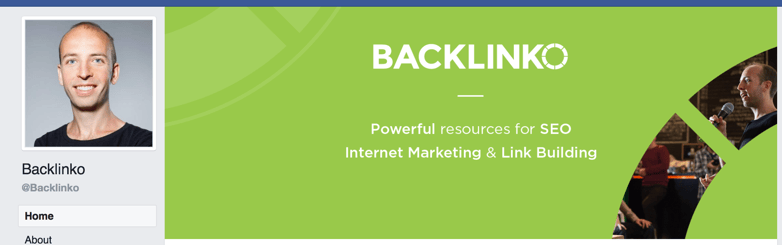
Their cover photo explains exactly what they do.
Unfortunately, many businesses are still missing out on a big opportunity. They don't use their covers to promote regular content, such as blog posts, infographics and videos.
So, consider changing your cover photo for each of your posts or events. It's not that hard, especially with the help of all the free online tools available to marketers.
So, consider changing your cover photo for each of your posts or events. It's not that hard, especially with the help of all the free online tools available to marketers.
3. Engaging Employees
Social media platforms offer a great opportunity for organizations to engage their employees in a social media marketing campaign.

Yet, so few businesses are tapping into the huge potential that comes with employee advocacy.
Just imagine what will happen if all of your employees take part in a promotional campaign and share your content with their 100+ friends.
That's a lot more eyes on your content and a huge increase in the organic social media reach.
Just look at all the big companies, such as Facebook. They all have employees who are constantly advocating for the brand and promoting their content.
You don’t see promotions about the growth and activities on Facebook only on the main fan page. The team is also sharing news and opinions that multiply the social media reach.
You can do the same.
But never force your employees to advocate for your brand. Find those people who'd love to do it, and give them a chance.
Paying for ads is cool and maintaining Facebook fan pages is necessary. But, that’s not where organizations should stop. Getting team members to promote content is crucial!
But never force your employees to advocate for your brand. Find those people who'd love to do it, and give them a chance.
Paying for ads is cool and maintaining Facebook fan pages is necessary. But, that’s not where organizations should stop. Getting team members to promote content is crucial!
4. Surveying the Audience in Real Time
 Have you ever wondered why successful organizations are doing surveys?
There are many reasons for it:
- Surveys let them get info about the audience’s perception of the products or services
- It’s really easy for an organization to conduct a survey
- The info a survey provides lets the organization make informed decisions
The good news is that surveys and survey requests are no longer limited to email. Companies can now survey their audience in real time via social media.
That means that a business can get instant feedback with a simple poll that asks a critical question.
So, don't be shy: ask away!
It's a great way to get your audience engaged (most people love to vote and answers surveys on social). At the same time, it's a wonderful opportunity to gather valuable information about your audience.
5. Combining Paid and Organic Marketing Strategies
 The era of TV commercials and other old-school methods is long gone.
Not only is social media advertising much cheaper than all the old methods, but it's also more targeted, and therefore- more effective.
Reddit, Facebook LinkedIn, Twitter, Instagram, and Pinterest all have advanced advertising platforms. They enable companies to reach the right target audience.
Paid ads should not to be neglected.
However, you should strive to combine them with organic, free marketing strategies.
Share blog posts, long-form content, unique images, and direct communication with the audience.
When combined with paid ads, these strategies will lead to inevitable success.
Paid ads should not to be neglected.
However, you should strive to combine them with organic, free marketing strategies.
Share blog posts, long-form content, unique images, and direct communication with the audience.
When combined with paid ads, these strategies will lead to inevitable success.
6. Publishing Long-Form Content on Social Media
 Looking at Twitter, it's easy to assume that social media is all about being brief and cool.
But that is not always so.
LinkedIn, for example, has its own publishing platform that allows users to post long-form content.
Facebook also allows you to write huge status updates. You can tap into these Facebook notes in order to share long-form opinions that the audience will easily find.
Social media platforms give companies unlimited space for sharing news, articles, promotional messages, and opinions.
It’s about time everyone realizes that.
Turning every single of your posts into an essay is not a good idea, but that doesn't mean you shouldn't share long-form content once in a while.
7. Having a Unique Strategy for Each Network

Even if you have profiles on several platforms, it's wrong to assume that your audience is the same on each network.
Still, most organizations decide to neglect the fact that the audience on each network is unique.
You've probably seen Instagram photos posted on Facebook, Twitter, Pinterest, and all other places at once.
Or how about brands that share the same piece of content and text on all platforms? There's so much of that!
But that's a big mistake.
Not only do the formats and dimensions differ for different platforms, but so do audience interests.
According to marketers at Essayontime, each network demands a unique strategy - one that is developed according to the special vibe the audience has.
8. Pinning Webinars and Blog Content on Pinterest
 Pinterest is a very powerful promotional platform.
Bloggers, makeup artists, fitness gurus, and chefs are using the full potential of Pinterest to promote their work.
Organizations, however, are lagging behind.
It’s time to stop overlooking Pinterest as a promotional platform.
If you pin images of your blog posts or webinar info pages to Pinterest, you're giving people a chance to repin that content.
By re-pinning they're making that content available to all of their audience and giving themselves a chance to check it out again later.
Who knows - they just might come back to it when they have time and follow the call to action.
9. Messaging Influencers and Followers

Many businesses are finally realizing and tapping into the power of influencer marketing.
If yours isn't one of them, it's time to start!
After all, if your build a relationship with an influencer you can ask them to promote your campaign and thus make your content available to their huge audience.
Of course, you can do that by posting high-quality content and waiting for influencers to react to it, but you'll probably have to wait a really long time...
The effects of influencer marketing can be much greater if you contact the influencer directly.
All social media platforms allow you to reach these industry leaders and engaged members of the community.
It’s easy to contact them and negotiate an offer, so give it a shot.
10. Focusing on the LinkedIn Profile
 When marketing experts want to promote an organization, they usually use Facebook, Twitter, and Instagram.
It’s strange that so many overlook LinkedIn, because they think that it’s purpose is to connect job hunters with employers.
But LinkedIn is a very influential network.
When each employee promotes the organization through their LinkedIn profile, the organization instantly gains more authority.
LinkedIn also has a great publishing platform you can tap into to share your content.
And there are lots of LinkedIn Groups where professions go every day to exchange great content.
11. Recruiting Skillful Employees

Companies invest a lot of money in proper recruiting.
That's understandable: in a competitive market, attracting high-impact employees is a hard goal to reach.
Through social media, however, organizations can avoid the expenses of hiring headhunters.
When you’re active on different platforms, it’s easy to locate outstanding candidates who are already engaged with your brand.
That means that you can attract potential hires just by promoting your vision and organizational culture via social media.
You can also use social media to gain more info about them, both from their "about" section and from what they share.
So, go out and look at who's interacting with your brand. Your next employee might be among them.
Final Thoughts
All organizations use social media for marketing. Are they doing it the right way?
Not always.
It’s time to realize that social media promotion needs a strategic approach. Businesses should create multiple touch points with potential consumers.
So, if you start implementing these 11 social media strategies, you'll create a more complete campaign that'll reach more people.
Now over to you:
Do you have other tips to share with us? Feel free to share!
By Joan Selby
Wednesday, 18 January 2017
The basics: 30 social media marketing tips for beginners
The basics: 30 social media marketing tips for beginners
I love when I see friends and co-workers hopping aboard and starting to embrace social media as a regular part of their work or personal lives.
Because many people are still learning, some insider tips are helpful and crucial to their effectiveness on their social media channels. Here is a bevy of tips, plus a bonus “cheat sheet” SlideShare deck.
Facebook
1. A fan page is for your company Facebook page; a profile page is for your personal page. Remember the difference, or Facebook will shut your page down. That would be a major “fail.”
2. Use the real estate available to you: Put up a great profile pic, have a bio, and add links to your other sites.
3. Add pictures. Pictures enable people to see what your brand is about and realize it’s more than just a “logo.” Upload pictures from events, conferences, demos, and just the regular everyday awesomeness in your office.
4. Be human! Don’t just post, post, post. No one wants to hear all about you, all the time. Ask questions, reply, and talk as you would in everyday life.
5. Share other people’s posts. Engage and demonstrate that you value content and opinions from others, too.
6. Connect your platforms. Did you write a blog post? Have it automatically post on your Facebook page so others can have access to it easily and quickly.
7. Have contests or other exciting giveaways or events, which encourage both online and offline participation with your brand via Facebook.
8. Update regularly, not occasionally. Fans grow accustomed to the regularity of posts; they will fall off your loyal fan wagon if you don’t keep up.
9. Use Facebook Insights to monitor your success with your fans and to see why and when your fans’ activity increases or decreases. It’s helpful for future campaigns and promotions.
10. Be relevant. Post content that provides value to your target audience, but also add some fun stuff, too. The 80/20 rule is a great way to start out: That’s 80 percent relevant content, 20 percent fun stuff. As seen below, Laughing Cow Cheese is always a great example of engagement, being human, and providing great relevant content on a consistent basis.

Twitter
1. Get a Twitter handle as simple and close to the name of you or your brand as possible. Refrain from names like Tommy9373, because no one will remember it.
2. Again, use your real estate wisely. Have a relevant 140-character bio that catches the eye of your target audience; use a great picture for your profile, and because some people use Twitter.com versus Hootsuite, Tweetdeck, etc., make sure your Twitter background is up to par as well.
3. Be polite. Don’t just blast out information. Twitter is a place for all of us to share, listen, chat together, and engage with one another. Remember: The words “please” and “thank you” are just as welcome in this space.
4. Listen first; talk second. Set up columns in your Twitter apps, such as Tweetdeck or Hootsuite, to listen to your target audience easier and better. For example, have separate columns for clients, prospects, competition, etc.
5. Use hashtags for events, conferences, products, etc., to promote more and listen better to the things people are saying about your brand, product, event, and so on.
6. Retweet other people’s updates. It’s not all about your own content and opinion.
7. Give credit where credit is due when curating other people’s content.
8. Use a link shortener. It’s there to help you say more in this 140-character world.
9. Share links, photos, videos, and more. Don’t limit yourself to articles and blog posts.
10. Follow back! Don’t be too cool to follow, because on Twitter we’re all a little nerdy.
Lululemon is a great example of a brand that knows how to retweet, ask questions, engage, and truly show its followers that it cares about each of them and what they have to say.

Blogging
1. Create a strategy for the content you would like to cover in your blog. Focus on your marketing strategy and the value you would like to provide your target audience. This will help you avoid many of the common blogging mistakes.
2. Have an editorial calendar to keep track of topics, bloggers, and deadlines.
3. Invite guest bloggers to write posts. They will add some spice to your regular content.
4. Post regularly or people forget you have a blog.
5. Make sure your “share” buttons are easily visible so people can tweet, share, and like your posts.
6. Put the “subscribe” buttons in a place where they won’t get lost. That way people can click and subscribe quickly and easily.
7. Allow people to comment on your posts. Monitor them closely if you want to approve the comments before they’re made public.
8. Including headings, subheadings, and list posts capture people’s attention. They’re easier to read than long paragraph after long paragraph.
9. Add visual stimulation with videos, embeds, pictures, graphs, and the like.
10. Show off your voice. Make it yours. Don’t be afraid to add a little pizzazz!
The Purse Blog is unique and visually stimulating with its pictures and posts.

Worried you’re going to forget some of these useful tips? Don’t fret.
Check out my “cheat sheet” below and feel free to download, print, and keep handy while you share, tweet, and write your awesome blog posts!
A version of this story first appeared on the oneforty blog.
Because many people are still learning, some insider tips are helpful and crucial to their effectiveness on their social media channels. Here is a bevy of tips, plus a bonus “cheat sheet” SlideShare deck.
1. A fan page is for your company Facebook page; a profile page is for your personal page. Remember the difference, or Facebook will shut your page down. That would be a major “fail.”
2. Use the real estate available to you: Put up a great profile pic, have a bio, and add links to your other sites.
3. Add pictures. Pictures enable people to see what your brand is about and realize it’s more than just a “logo.” Upload pictures from events, conferences, demos, and just the regular everyday awesomeness in your office.
4. Be human! Don’t just post, post, post. No one wants to hear all about you, all the time. Ask questions, reply, and talk as you would in everyday life.
5. Share other people’s posts. Engage and demonstrate that you value content and opinions from others, too.
6. Connect your platforms. Did you write a blog post? Have it automatically post on your Facebook page so others can have access to it easily and quickly.
7. Have contests or other exciting giveaways or events, which encourage both online and offline participation with your brand via Facebook.
8. Update regularly, not occasionally. Fans grow accustomed to the regularity of posts; they will fall off your loyal fan wagon if you don’t keep up.
9. Use Facebook Insights to monitor your success with your fans and to see why and when your fans’ activity increases or decreases. It’s helpful for future campaigns and promotions.
10. Be relevant. Post content that provides value to your target audience, but also add some fun stuff, too. The 80/20 rule is a great way to start out: That’s 80 percent relevant content, 20 percent fun stuff. As seen below, Laughing Cow Cheese is always a great example of engagement, being human, and providing great relevant content on a consistent basis.
1. Get a Twitter handle as simple and close to the name of you or your brand as possible. Refrain from names like Tommy9373, because no one will remember it.
2. Again, use your real estate wisely. Have a relevant 140-character bio that catches the eye of your target audience; use a great picture for your profile, and because some people use Twitter.com versus Hootsuite, Tweetdeck, etc., make sure your Twitter background is up to par as well.
3. Be polite. Don’t just blast out information. Twitter is a place for all of us to share, listen, chat together, and engage with one another. Remember: The words “please” and “thank you” are just as welcome in this space.
4. Listen first; talk second. Set up columns in your Twitter apps, such as Tweetdeck or Hootsuite, to listen to your target audience easier and better. For example, have separate columns for clients, prospects, competition, etc.
5. Use hashtags for events, conferences, products, etc., to promote more and listen better to the things people are saying about your brand, product, event, and so on.
6. Retweet other people’s updates. It’s not all about your own content and opinion.
7. Give credit where credit is due when curating other people’s content.
8. Use a link shortener. It’s there to help you say more in this 140-character world.
9. Share links, photos, videos, and more. Don’t limit yourself to articles and blog posts.
10. Follow back! Don’t be too cool to follow, because on Twitter we’re all a little nerdy.
Lululemon is a great example of a brand that knows how to retweet, ask questions, engage, and truly show its followers that it cares about each of them and what they have to say.
Blogging
1. Create a strategy for the content you would like to cover in your blog. Focus on your marketing strategy and the value you would like to provide your target audience. This will help you avoid many of the common blogging mistakes.
2. Have an editorial calendar to keep track of topics, bloggers, and deadlines.
3. Invite guest bloggers to write posts. They will add some spice to your regular content.
4. Post regularly or people forget you have a blog.
5. Make sure your “share” buttons are easily visible so people can tweet, share, and like your posts.
6. Put the “subscribe” buttons in a place where they won’t get lost. That way people can click and subscribe quickly and easily.
7. Allow people to comment on your posts. Monitor them closely if you want to approve the comments before they’re made public.
8. Including headings, subheadings, and list posts capture people’s attention. They’re easier to read than long paragraph after long paragraph.
9. Add visual stimulation with videos, embeds, pictures, graphs, and the like.
10. Show off your voice. Make it yours. Don’t be afraid to add a little pizzazz!
The Purse Blog is unique and visually stimulating with its pictures and posts.
Worried you’re going to forget some of these useful tips? Don’t fret.
Check out my “cheat sheet” below and feel free to download, print, and keep handy while you share, tweet, and write your awesome blog posts!
A version of this story first appeared on the oneforty blog.
Subscribe to:
Posts (Atom)